.webp)


Continue Your Journey
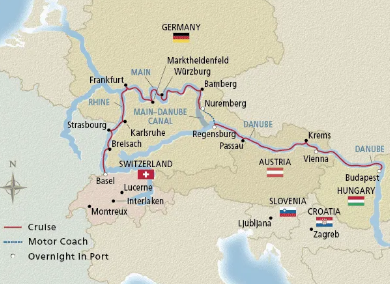
18 Day Rhine, Main & Danube Odyssey

.webp)
Historic Highlights and Scenic Gems
Sail along the Main and Rhine to see Basel, often regarded as Switzerland’s cultural capital, and sample the distinctive flavors of the Alsace region. Discover Frankfurt, a high-powered business hub, and visit the historic towns of Bavaria and Baden-Württemberg. See Salzburg, explore Göttweig Abbey and make dumplings with Wachau Valley apricots. Celebrate the musical heritage of Vienna and experience the healing qualities of Budapest’s thermal baths.
*14 nights in the same stateroom: + $100pp (double occupancy)
*14 nights in the same stateroom: +$200pp (single occupancy)
*There are only a limited amount of staterooms available on each sailing where moving is not going to be necessary.
Your Cruise
- 18 Day Rhine, Main & Danube Odyssey Cruise
- Taxes
CruisePlus Booking Bonus
- Onboard Credit - Ask Us
Viking River Booking Bonus
- FREE Airfare from select gateways - Ask us about your gateway!
- One complimentary shore excursion in every port of call
- Free Wi-Fi (connection speed may vary)
- All onboard meals, featuring regional specialties & always available classics
- Beer, wine & soft drinks with onboard lunch & dinner
- 24-hour specialty coffees, teas & bottled water
- Port taxes & fees
- Visits to UNESCO Sites
- Enrihgment lectures & Destination Perfomances

Priority Access
» Priority check-in
» Priority access to specialty restaurant reservations
» Priority line at the Guest Services desk
» Priority line at the Shore Excursions desk
» Priority access to tenders ashore in select ports
» Priority disembarkation
Premium Dining
» Expanded 24-hour room service breakfast menu
» Pinnacle Class ships: Private dining venue for breakfast and dinner with an expanded menu
» All other ships: Priority seating in the Dining Room for breakfast and dinner with an expanded menu
Exclusive Amenities
» Complimentary stateroom upgrade
» Dedicated concierge service
» Welcome glass of sparkling wine on embarkation day
» Premium bathrobes
» Club Orange keycard
» Exclusive Club Orange tote bag (one per stateroom)
More information

Fisherman's Bastion
Built in the early 20th century in a neo-Gothic style, the seven towers were built for the panoramic view of of Margret Island across the Danube. It was named after the Guild of Fisherman, who were responsible for guarding this portion of the Danube during the Middle Ages.

.avif)
Hofburg Palace
Hofburg Palace is a magnificent palatial complex that pays tribute to the power and influence of the Habsburg dynasty and served as the main winter palace for the rulers of the Austro-Hungarian Empire for hundreds of years.
.avif)
Spalentor, Basel, Switzerland
This regal, 15th-century gateway is one of 3 remaining from the city's ancient walls.
.avif)
Day 1 Budapest, Hungary
Embark your ship and settle into your stateroom. Riverside beauty and a vibrant cultural scene blend together in Budapest to form one of Europe’s most rewarding cities. Hungary’s enchanting capital straddles the banks of the Danube, with traditional hillside Buda on one side and modern Pest on the other. By day, stunning art nouveau buildings, stalwart castles and grand palaces set the stage for inspiring strolls and long soaks in thermal spas. By night, the shimmering lights of the Parliament building dance across the waters of the Danube, the Chain Bridge uniting it all as a dramatic centerpiece.
Day 2 Budapest, Hungary
Budapest’s old town is a fascinating medieval patchwork of narrow streets and colorful houses. In the Castle District, the Matthias Church soars in Gothic glory. Adjacent, the expansive wall and seven turrets of Fisherman’s Bastion overlook the Danube, the graceful Chain Bridge and the Pest side of the river. The centerpiece of the district is the sprawling Buda Castle. Constructed in the 13th century and expanded to its current baroque splendor during the 18th century, this edifice was home to Hungary’s kings for almost 700 years.
Scenic Sailing: Danube Bend
Take in the natural beauty of the fabled “Blue Danube” as you pass through the Danube Bend, considered one of the most beautiful sections of the river. Cruising this 40-mile stretch through northern Hungary, you will see peaceful farmland and an ancient castle that once served as hunting grounds for royals and visiting dignitaries. As you sail the passage between the Börzsöny and Pilis Ranges, you will marvel at the steep hills draped with bucolic forests. And delight in the majestic church domes peering at the waterway from inviting villages and historic cities.
Day 3 Vienna, Austria
Renowned as the “City of Waltzes,” Austria’s capital city of Vienna is Europe’s center of classical music. Strauss and Mozart composed many of their finest pieces here. Vienna’s musical history is matched by the elegant, graceful architecture that lines the Ringstrasse, the wide boulevard encircling the Inner City. Baroque, neo-Renaissance, Gothic-Romanesque and other splendidly styled structures, from the Hofburg Palace to the Vienna State Opera, take the breath away with their grand facades. Vienna has a more intimate side too: inviting footpaths lead through green parks and its famed Viennese cafés sweeten any stay with coffee and the city’s delectable Sachertorte.
Day 4 Vienna, Austria
Vienna is considered one of Europe’s greatest cultural hubs. Its art scene has long been established with the Hapsburg’s collection of fine art, now housed at the Kunsthistorisches Museum. Today, Vienna’s modern side showcases street art murals that don the side of buildings along the banks of the Danube. Ingrained in local life is the long-embraced tradition of coffeehouses; UNESCO includes Viennese coffeehouse culture on its list of Intangible Cultural Heritages. It is considered one of life’s pleasures to while away an afternoon over an Einspänner coffee and a pastry.
Day 5 Krems, Austria
A small university town at the eastern end of the Danube’s Wachau Valley, Krems is surrounded by terraced vineyards. In its heyday, during the 12th century, Krems held even more importance than Vienna for its iron, grain, salt and wine trade. As to the latter, the city has played a long and celebrated part in the popularity of the Wachau’s wine culture; the valley’s south slopes in Krems are bathed in sunlight all day and create some of the best Riesling and Veltliner wines in the world. The city’s cobblestone streets, taverns, wine bars and coffeehouses have a timeless appeal.
Scenic Sailing: Wachau Valley
Sail through a serene tapestry of terraced vineyards, forested slopes, charming towns and castle ruins in Austria’s Wachau Valley, celebrated as perhaps the most scenic stretch of the Danube. Journey 18 miles through this vast UNESCO World Heritage Site, where the river courses through picturesque hillsides. Gaze upon the prolific grapevines and quaint wine-producing villages hugging the shores—the legacy of vintners that stretch as far back as Celtic and Roman times and an echo of the more than 30 monasteries that served as vineyards in Renaissance days.
Day 6 Passau, Germany
Founded by the Celts over 2,000 years ago, Passau is one of Bavaria’s oldest cities. Known as the “City of Three Rivers,” it rests at the confluence of the Inn, Ilz and Danube rivers. The city has long enjoyed its strategic position and grew to great economic and political power because of it. The legacy of its past prosperity lives on in graceful arcades, colorful houses with rococo facades and the glorious baroque St. Stephen’s Cathedral, home to one of Europe’s largest pipe organs. Passau is also where two nations meet; it is here that the German-Austrian border begins.
Day 7 Regensburg, Germany
Having escaped major damage during World War II, the picturesque town of Regensburg is one of Europe’s best-preserved medieval cities, the oldest city along the Danube and a UNESCO World Heritage Site. The Old Stone Bridge, constructed in the 12th century, is a masterpiece of medieval engineering with its 16 arches. St. Peter’s Cathedral is widely considered Bavaria’s best Gothic architectural work. The old town’s Neupfarrplatz square is a cross section of history—it was once a thriving Jewish quarter, a bustling marketplace and the site of Nazi book burnings.
Day 8 Regensburg, Germany
Regensburg dates back to Roman times and was the first capital of Bavaria. Today, the city has a laid-back atmosphere and its warren of narrow alleys are a delight to explore. Amid its riverside streets is the small Alte Wurstküche tavern, the world’s first sausage kitchen. It opened its doors in the 12th century to serve the construction workers of the Old Stone Bridge and St. Peter’s Cathedral, making it the first fast-food restaurant ever. In line with Bavarian tradition, visits to the pub are customary for many of the locals and serve as a ritual of community life. After breakfast, disembark your ship before setting out on a relaxing included excursion.
Nuremburg, Germany
This afternoon, transfer to your next ship to begin your voyage. The second-largest city in Bavaria, Nuremberg is filled with traditional half-timbered houses and Gothic churches with intricate spires. Although nearly destroyed during World War II, the remaining medieval city walls stretch some three miles and feature original gateways and 80 original watchtowers. Nuremberg is well known historically for its metal and toy craftsmanship. But it is infamous for its role in World War II, first as the site of Zeppelin Field’s Nazi rallies and later as the site of the war crimes trials at the Palace of Justice that captured the attention of a generation.
Day 9 Nuremburg, Germany
Within the medieval walls of Nuremberg, Old Town is a place frozen in time. Its rustic half-timbered houses, ornate Gothic churches and cobblestone lanes form a fairy-tale scene. Looming above all is the Imperial Castle, which hosted the coronation of Holy Roman Emperors and the exaltation and entombment of saints. Completed in 1000 AD, it was a formidable fortification and provided a central seat of power for German kings. Nuremberg became the unofficial capital of the empire for 600 years, hosting courts and the Diet, periodic assemblies that shaped policy and strategy.
Day 10 Bamberg, Germany
Founded in 902, Bamberg remains a medieval-looking city known for its symphony orchestra and rauchbier, specialty smoked beer. The city’s winding streets are filled with baroque patrician houses and are home to the stunning 11th-century Cathedral of Holy Roman Emperor Heinrich II, housing his tomb and that of Pope Clement II. Bamberg is especially noted for its Altes Rathaus, or Old Town Hall, situated on a twin-arched bridge over the Regnitz River, and for the old bishop’s houses: the 16th-century Alte Hofhaltung (Old Court) and 17th-century Neue Residenz (New Residence).
Day 11 Würzburg, Germany
Surrounded by Franconian vineyards, Würzburg was heavily damaged during World War II, but has since been completely restored. This prestigious university city is a jewel of baroque architecture. Its most pristine example of pomp and glory is the great Bishops’ Residenz palace, built in 1744 for the prince-bishop; his unwavering support of artists is evidenced by the sweeping staircase and magnificent ceiling frescoes by Tiepolo. Other landmarks include the medieval, statue-lined Old Main Bridge and Marienberg Fortress, originally a Celtic hill fort and later residence of the bishops. The city remains a major wine-making center, hosting Germany’s oldest and largest vineyard.
Day 12 Marktheidenfeld, Germany
Marktheidenfeld is a picturesque town situated in the Lower Franconia region of Bavaria and boasts a rich heritage that dates back to medieval times. Well-preserved, half-timbered houses line quaint streets and in its heart lies a bustling Marktplatz, or market square, that exudes character and a vibrant atmosphere. Local restaurants serve traditional hearty Bavarian fare, including delicious dishes such as Schweinshaxe (pork knuckle), Kaiserschmarrn (scrambled caramelized pancake) and the more commonly known bratwurst.
Scenic Sailing: Main River, Spessart
Journey along one of Germany’s most important waterways today, passing landscapes that embody the country’s scenic beauty and storybook charm. You will sail by quaint riverside villages, undulating farm country and the sylvan forests of the Spessart woodlands. Along the way, you just may lose yourself in the dreamy canvases of half-timbered houses, historic castles and splendid palaces. This is the Germany once ruled by dukes and brought to magical life by the imagination of the Brothers Grimm, who grew up in the town of Hanau and wove fantastic tales from these banks.
Day 13 Frankfurt, Germany
Straddling the Main River, Frankfurt has been nicknamed “Mainhattan” for its skyline that resembles that of Manhattan. It is a major financial center and a rich hub of culture, history and architecture. No fewer than nine museums line the Main embankment, covering everything from art to film to ethnology. In the Roman Hill district, Frankfurt’s town hall spreads out over 11 conjoined patrician houses. Emperors were crowned in the Gothic St. Bartholomew’s Cathedral, and remnants from Roman settlements are on exhibit in the city’s Archaeological Garden.
Day 14 Karlsruhe, Germany
Blending tradition and modernity, Karlsruhe is one of southwest Germany’s cultural gems. Founded as the Grand Duchy of Baden during the early-18th century, the city is home to the majestic Karlsruhe Palace, from which the city’s streets span forming a distinctive circular layout. Innovation is ingrained in the city’s DNA; it was the chosen destination to establish the world-renowned Karlsruhe Institute of Technology in 2009. Numerous museums, theaters and galleries are popular sights to explore, as well as the peaceful green spaces that offer a serene escape from city life.
Day 15 Strasbourg, France
The largest port on the Upper Rhine, Strasbourg is the cultural center of France’s Alsace region. Thanks to its location at the border of France and Germany, it boasts a convivial mix of cultural influences. The well-preserved old town is enclosed on all sides by the little Ill River, with sites so compact that it is easy to explore the “island” on foot. And there is plenty to explore: cobblestone streets lined with wooden houses and intersected by picturesque canals. Indulging in Alsatian café culture is central to any visit here; enjoy coffee and cake amid lovely half-timbered houses.
Day 16 Breisach, Germany
Breisach is a gateway to the fabled Black Forest region, built on a basalt rock outcropping in the Rhine plain. It is located in one of the warmest parts of Germany, across the river from French Alsace, famous for its wine growing. But Breisach, too, can boast about its wine: it is home to Europe’s largest cellars, with a storage capacity of more than 160 million liters. The most prominent landmark of Breisach is the Romanesque-Gothic St. Stephen’s Cathedral, built between the 12th and 13th centuries. Its two towers are visible from throughout the city and from the Rhine.
Day 17 Basel, Switzerland
Located where Switzerland, Germany and France meet, Basel reflects a fascinating blend of traditions. The city straddles the Rhine at the river’s farthest navigable point, and an alluring cluster of old-town buildings huddles along the riverbank. Around Market Square, guild houses recall Gothic, Renaissance and baroque splendor; the red-sandstone Rathaus, or Town Hall, is the centerpiece. More than 40 museums of art and culture lend modern polish to its history-rich streets. And there is no more refined way to sample it all than over cheese fondue or croissants.'
Day 18 Basel, Switzerland
Bid farewell to your fellow guests and journey home. Or spend more time exploring, perhaps joining one of our extensions.
However, no representation or description of the protection made by CruisePlus Management Ltd to you, constitutes a binding assurance or promise about the protection. We (CruisePlus) are not an insurance company and we do not have the responsibility for ensuring adherence to the insurance terms & conditions, submission, payment or adjustment of claims.
We strongly suggest you read through the insurance information provided upon purchase and email us with any questions.
Covid-19 is considered a known event and exclusions apply for most, if not all policies.